
No hot water? An error code flashing on the display? A unit that was already old when you bought the house? Fast Track Plumbing repairs, flushes, and replaces tankless water heaters across Tampa Bay, and the licensed plumber who answers your call is the one who shows up to do the work.
Repair Or Replace
It is the first question almost everyone asks, and it deserves a straight answer instead of a sales pitch.
Here is the rule Fast Track Plumbing actually uses: when the cost to fix a tankless approaches the cost to replace it, replace it. Repairing a tankless is slow, careful work. Parts have to be ordered, and on older units the parts often no longer exist. Most of the tankless heaters Fast Track Plumbing gets called out to are 15 or more years old. At that age, even when a repair is possible, you are putting new money into a unit at the end of its life, and the repair carries no meaningful warranty. A new unit comes with real manufacturer coverage and starts the clock over.
A rough guide from the jobs Fast Track Plumbing actually runs:
One recent call came from a unit made by a Japanese brand that has not been sold in the United States in years. The heater was around 20 years old. No parts, no manual, no path to a repair. That is what old age looks like in a tankless, and it is why Fast Track Plumbing will tell you plainly when fixing is a bad deal.
Common Tankless Issues
Fast Track services all major tankless brands, whether or not we installed the unit, including heaters bought at a big-box store or online. Gas and electric both, though gas is the bigger part of the work in Tampa Bay.
Error Code Guide
Air supply or exhaust blockage
No ignition. Gas supply, igniter, or flame rod
Flame failure while running
Temperature sensor fault
Water leak detected inside the unit
Scale buildup in the heat exchanger
Tankless Maintenance
Fast Track Plumbing has measured hardness across Tampa Bay homes doing water treatment work, and the readings tell the story:typically 12 to 18 grains per gallon, with the highest he has personally measured at around 24 to 25.Downtown Tampa tends to run a little worse than Pinellas, but the whole Bay runs hard. The U.S. Geological Survey classifies water far softer than ours as “very hard.”
12-18 GPG
Typical Tampa Bay water hardness.
20+ YEARS
Potential lifespan with proper maintenance.
jobs Fast Track Plumbing sees every week
The difference maintenance makes is not small. In our experience it can be about a 10 year difference in the life of the unit. A tankless that gets flushed on schedule can run 20 years or more. One that never gets serviced in Tampa water may not see 12. Skipping a flush does not save money. It just moves the bill to the worst possible line item.
There is a paperwork reason too: manufacturers can void the warranty on a unit with no maintenance records. The flush is not just protecting the heater. It is protecting your coverage.
The Flush Process
Homeowners call it a flush. Plumbers call it descaling the tankless. Either way, here is what the visit involves, so you know what you are paying for:
Fast Track Plumbing connects a pump and hoses to the unit's service valves and circulates a descaling solution through the heat exchanger for about 45 minutes to an hour, dissolving the mineral buildup from every passage the water touches.
The unit gets flushed with clean water until it runs clear, carrying the loosened scale out with it.
The inlet filter screen gets cleaned, the burner gets inspected, the sensors get checked, and any stored error codes get read and cleared.The inlet filter screen gets cleaned, the burner gets inspected, the sensors get checked, and any stored error codes get read and cleared.
The unit gets run and verified: temperature rise checked against spec, flow rate confirmed at the fixtures.
If the unit has never been serviced, you can see the problem leave the house. The water comes out brown, with actual chunks of scale in it. Even a unit only two years old in Tampa water can run surprisingly dark. We will show you the flush water when he is done. It is the most honest before-and-after in plumbing.
Tankless Be Flushed
Tampa Bay city water, no softener
The softener row surprises people, so it is worth saying twice: yes, a softened home still flushes annually. What changes is what we find when he opens it up. Softened homes run cleaner and their heaters last longer. Unsoftened homes are where the brown water comes from.
Honest Answers
Fair question. People ask it in plumbing forums every week, usually right after a plumber quoted them a few hundred dollars for maintenance on a heater that seems to work fine. Here is the honest version.
Mechanically, yes. A pump, two hoses, and food-grade white vinegar will do a serviceable job, and a careful homeowner can handle it. We would rather tell you that than pretend otherwise. But most people do not do it, and skipped years in Tampa water are what turn a $400 maintenance visit into a heat exchanger replacement. The professional visit also covers the parts a bucket of vinegar cannot: the filter, the burner, the flame rod, the sensors, the stored error codes, and the maintenance record that keeps your warranty intact.
In this water, yes, and the unit will tell you itself. Rinnai heaters literally display a scale code (LC) when buildup gets bad enough. The 10 year lifespan difference between serviced and neglected units is not a brochure number. It is what Luke sees in the field, week after week, one brown bucket at a time.
And if you would rather never think about it: that is what the membership is for.
Tankless Pricing
How many units and how long the descale takes. Free for members.
The part, the brand, and the age of the unit. We will tell you honestly when a repair is not worth it.
Mostly the state of your gas line and venting. A straight swap sits at the low end. Moving pipes moves the price
Membership Plan
Why Rinnai
When a replacement is the right call, we recommends Rinnai, and he is certified by Rinnai to install and service their units. The reasons are practical, not brand loyalty:
Fast Track Plumbing will install another brand if you ask him to. He will also tell you what he would put in his own house.

Tank-To-Tankless Conversion
A tankless conversion is not a swap. A tankless burns four to five times the gas of a tank heater at full fire, so the existing gas line usually has to be upsized. The old B-vent cannot be reused, so new direct venting goes in. High-efficiency condensing models also need a drain for the acidic condensate they produce. This is exactly where inexperienced installers cut corners, and bad venting is the mistake we see most from other people’s installs.
Every conversion is permitted and inspected. In nearly every Florida jurisdiction a water heater replacement requires a permit, and a tank-to-tankless conversion adds gas, venting, and combustion air review on top. Fast Track handles the permits, and the job is done to code and passes inspection, which matters again the day you sell the house.
Whether the switch is worth it mostly comes down to how much you value endless hot water, the wall space you get back, and how long you plan to stay. We will give you the honest math for your house, including when keeping a tank is the better answer.
Water Quality Matters
Scale is why tankless heaters struggle in Tampa, and a water softener is the tool that slows scale down at the point of entry. Softened homes need the same annual flush, but their heaters run cleaner, last longer, and so does everything else the water touches. If you want to know what your water is actually doing to your home, We test it, measures the hardness in grains, and builds a treatment system matched to your house rather than selling a box off a shelf. See our water softener and water filtration pages, or ask about it during your tankless visit.
Meet Your Plumber
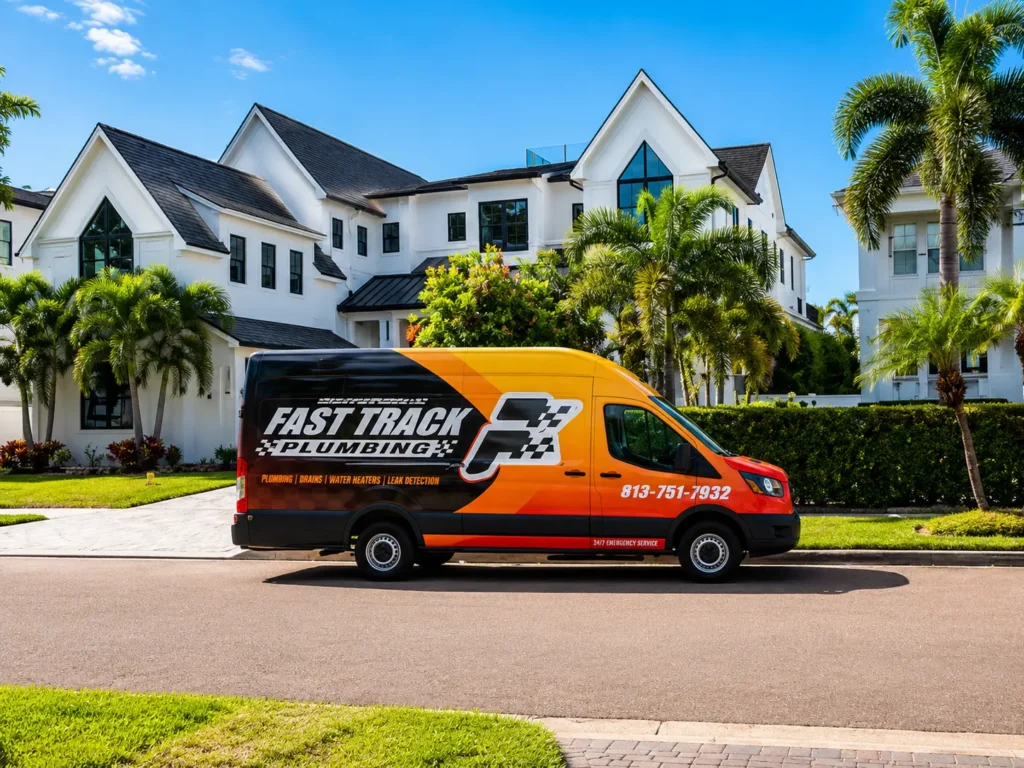
Fast Track Plumbing is owned and run by Luke, a Tampa local, State Certified Plumbing Contractor (license #CFC1433909, verifiable with the State of Florida), Master Plumber, and Rinnai certified for tankless work. When you book a tankless job, we arrive with the truck stocked to do the work that day. No inspector who quotes and leaves, no crew you have never spoken to.
His edge, in his own words, is speed: he can get there quicker and get it done faster. A typical tankless job runs three and a half to four hours, and most work is completed the same day you call.
Recent Projects
"Luke was polite, efficient, and definitely knew how to get the job done. He truly cares about helping his customers and left absolutely no mess behind."
- Cj Augustine
"Fast Track arrived on time and provided very fair pricing for the work needed. It was honestly the best plumbing experience I've had."
- Eric G
"You did a magnificent installation job. First class work."
- Ronald Williams, tankless installation
Tampa Bay Service Area
Tankless FAQs
In Tampa water, the flush itself is genuinely necessary, and the unit will eventually tell you so with a scale code. Whether a professional does it is your call. A careful homeowner with a pump kit can descale a unit. The professional visit adds the burner, sensor, and filter service, plus the maintenance record that protects your warranty. Members get it included, which settles the question for $19.99 a month.